


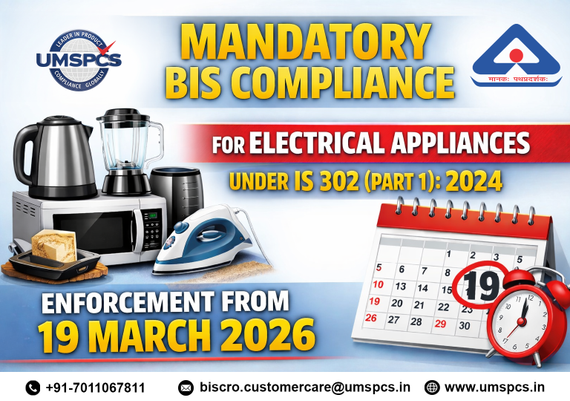
India’s regulatory framework for electrical safety is entering a crucial phase with the enforcement of IS 302 (Part 1): 2024, harmonized with IEC 60335-1:2020. As notified by the Department for Promotion of Industry and Internal Trade (DPIIT), this updated Indian Standard will become mandatory from 19 March, 2026 for a wide range of electrical appliances.
Manufacturers, importers, and brand owners dealing with household and commercial electrical products must begin preparations early. Non-compliance after the enforcement date may result in penalties, product recalls, or restrictions on sale within the Indian market.
Scope of the New Standard
The enforcement of IS 302 (Part 1): 2024 applies to:
-
All electrical appliances intended for household, commercial, or similar applications
-
Appliances with rated voltage not exceeding 250 V for single-phase appliances
-
Appliances with rated voltage not exceeding 480 V for other appliances
-
Direct current (DC) supplied appliances
-
Battery-operated appliances
The scope is extensive and includes products widely used in homes, offices, and commercial spaces. The primary objective is to ensure protection against hazards such as electric shock, overheating, fire risks, insulation breakdown, and mechanical failure.
Understanding IS 302 (Part 1): 2024
IS 302 (Part 1): 2024 outlines general safety requirements for electrical appliances and aligns Indian safety norms with international practices under IEC 60335-1:2020. The standard specifies:
-
Construction and design safety parameters
-
Electrical insulation and protection guidelines
-
Temperature rise limits
-
Safeguards against electric shock
-
Mechanical durability standards
-
Prescribed laboratory testing procedures
The revised framework replaces earlier provisions and introduces updated safety expectations. Manufacturers must review product design, component selection, and internal quality systems to ensure full compliance.
Role of DPIIT in Enforcement
The Department for Promotion of Industry and Internal Trade (DPIIT) issues Quality Control Orders (QCOs) that make compliance mandatory for selected products. These notifications aim to enhance consumer protection and ensure uniform product safety standards across India.
Although a transition period has been provided until 19 March, 2026, businesses should initiate preparations immediately due to the technical, documentation, and testing requirements involved.
Products Covered – Illustrative Categories
Electrical appliances likely covered under this regulation include:
-
Electric irons
-
Microwave ovens
-
Electric kettles
-
Induction cooktops
-
Washing machines
-
Refrigerators
-
Water heaters
-
Room heaters
-
Air coolers
-
Power adapters and battery-operated devices
Manufacturers must evaluate their product portfolio to determine applicability under IS 302 (Part 1): 2024.
Certification Requirements
To continue manufacturing, importing, or selling regulated electrical appliances after the enforcement date, businesses must:
-
Apply for certification with the Bureau of Indian Standards (BIS).
-
Conduct product testing in BIS-recognized laboratories as per IS 302 (Part 1): 2024.
-
Establish and maintain documented quality control systems.
-
Obtain a valid BIS license before market distribution.
These obligations apply to both Indian manufacturers and foreign exporters supplying products to India.
Key Compliance Challenges
Transitioning to the updated standard may require:
-
Product redesign to meet revised safety norms
-
Upgrading insulation and protective components
-
Fresh testing as per updated procedures
-
Preparation of detailed technical documentation
-
Timely coordination with BIS authorities
Without structured planning, businesses may face approval delays or last-minute operational disruptions.
Why Early Preparation Matters
Delaying compliance efforts can create bottlenecks in testing laboratories and slow down certification approvals. Early preparation ensures:
-
Smooth testing schedules
-
Sufficient time for product modifications
-
Faster license approval
-
Continuity in production and sales
Electrical safety compliance directly influences brand trust and market credibility. Certified products demonstrate responsibility and adherence to recognized safety standards.
Why Choose UMSPCS
When dealing with evolving regulatory requirements such as IS 302 (Part 1): 2024, professional guidance can make a significant difference. UMSPCS offers structured, compliance-focused consultancy services designed to simplify the BIS certification journey.
Businesses choose UMSPCS because of:
-
Strong understanding of BIS regulations and Quality Control Orders
-
Practical experience in handling electrical appliance certification
-
Transparent documentation support
-
Step-by-step guidance from application to license grant
-
Timely communication and regulatory updates
Our approach is based on careful evaluation, technical accuracy, and proactive compliance management.
How We Can Help You
UMSPCS provides end-to-end support to manufacturers and importers preparing for mandatory BIS compliance under IS 302 (Part 1): 2024. Our assistance includes:
-
Product applicability assessment
-
Detailed gap analysis of existing designs
-
Coordination with BIS-recognized laboratories for testing
-
Preparation and review of technical documentation
-
Support during factory inspections
-
Continuous follow-up with BIS authorities
-
Post-certification compliance guidance
We work closely with your engineering and quality teams to ensure your products meet updated safety standards well before the enforcement deadline. Our objective is to minimize regulatory risks while ensuring smooth and timely certification.
Impact on the Indian Market
The enforcement of IS 302 (Part 1): 2024 represents a progressive step toward strengthening electrical safety across India. Consumers will benefit from safer and more reliable appliances, while compliant manufacturers will enhance their competitive advantage in both domestic and global markets.
For businesses, compliance is not merely a statutory obligation—it is an investment in product quality, safety, and long-term growth.
Conclusion
The mandatory implementation of IS 302 (Part 1): 2024 from 19 March, 2026 marks a major regulatory milestone for the electrical appliance sector in India. Covering household, commercial, DC, and battery-operated appliances within defined voltage limits, the regulation aims to elevate national safety standards.
Manufacturers and importers should initiate compliance planning immediately. With proper preparation and expert guidance from UMSPCS, businesses can achieve timely BIS isi certification, maintain uninterrupted operations, and confidently contribute to a safer electrical marketplace in India.


