


Introduction
Electrical safety in any installation depends not just on protection devices like circuit breakers and fuses, but equally on the ability to safely isolate circuits and equipment for maintenance, testing, and repair. The electrical isolator is the device that provides this capability, creating a verifiable open circuit between a power source and the equipment connected to it. Understanding what isolators are, how they differ from circuit breakers, and how to select the right isolator for a given application is fundamental knowledge for electricians, engineers, and facility maintenance teams.
This post covers the purpose and function of electrical isolators, the different types available including the commonly used 32A Isolator, key selection criteria, and the importance of correct installation practice.
What Is an Electrical Isolator?
An electrical isolator is a mechanical switching device that provides a physical, verifiable disconnection of a circuit or piece of equipment from its power supply. Unlike a circuit breaker, which trips automatically in response to a fault, an isolator is a purely manual device with no automatic tripping capability. Its sole function is to safely disconnect a circuit so that work can be performed on downstream equipment without the risk of the supply being reconnected accidentally.
The critical safety feature of an isolator is that it provides a visible open gap or a confirmed open position indicator, allowing maintenance personnel to verify with certainty that the circuit is isolated before touching live parts. This visible isolation is required by most electrical installation standards and is an essential element of lockout-tagout procedures in industrial environments.

How Isolators Differ from Circuit Breakers
The difference between an isolator and a circuit breaker is often misunderstood, as both devices are used to control electrical circuits. However, their functions and applications are fundamentally different. A circuit breaker is a protective device designed to automatically interrupt the flow of electricity during abnormal conditions such as overloads or short circuits. It has a defined fault interruption capacity and plays a critical role in preventing damage to electrical systems and ensuring safety.
In contrast, an isolator is primarily a safety device used to disconnect a circuit from the power supply when it is not carrying current or under minimal load. It is not designed to handle or interrupt fault currents and should never be operated under full load conditions. Its main purpose is to provide a visible and secure disconnection point for maintenance and servicing activities.
Importantly, isolators and circuit breakers are used together, not interchangeably. The circuit breaker provides protection by handling faults, while the isolator ensures safe and complete disconnection during maintenance. This combination enhances overall electrical safety and operational reliability.
Types of Electrical Isolators
Electrical isolators are essential safety devices used to disconnect electrical circuits from the power supply during maintenance or emergencies. They ensure complete isolation of equipment, preventing accidental current flow and protecting both users and systems. Available in various designs and configurations, isolators are selected based on application, current rating, and installation type in residential, commercial, and industrial environments.
Rotary Isolators
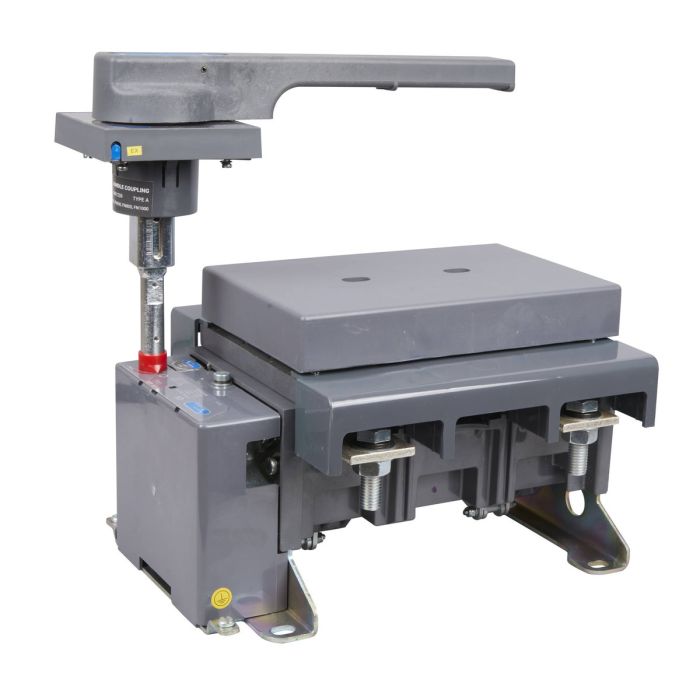
Rotary isolators use a rotating handle to open and close the contacts. They are compact, available in a wide range of current ratings from below 20A to several hundred amperes, and are widely used in residential and commercial distribution boards as main switches and as isolation points for individual circuits or equipment. The 32A Isolator in rotary form is one of the most commonly specified ratings for appliance isolation in commercial premises and residential high-current circuits.
Modular Isolators
Modular isolators are designed for DIN rail mounting in standard distribution boards. They are available in single, double, triple, and four pole configurations and cover current ratings from 16A to 125A for standard residential and commercial applications. The 32A Isolator in modular form is often used as an isolation point for individual circuit sub-boards, air conditioning equipment, and water heaters.
Fused Isolators
Fused isolators combine the isolation function with fuse-based overcurrent protection in a single device. They are used where both functions are required in a compact assembly, particularly in industrial panel applications.
Key Selection Criteria for Isolators
- Current rating: Must equal or exceed the maximum current that will flow through the isolator when the circuit is energized and carrying load. For the 32A Isolator specifically, this suits circuits for appliances and equipment drawing up to 32A continuously.
- Voltage rating: Must match the system voltage, 230V AC for single phase, 415V AC for three phase.
- Number of poles: Single phase circuits use 2P isolators (switching both live and neutral). Three phase circuits require 3P or 4P isolators.
- Breaking capacity: While isolators are not designed for fault interruption, they must be rated to safely make and break the full load current of the circuit.
- Padlocking facility: For applications requiring lockout-tagout procedures, select an isolator with a built-in padlock hasp to prevent re-energization during maintenance.
Installation and Safety Practices
An isolator must always be installed upstream of the equipment it is intended to isolate, between the circuit breaker or fuse and the equipment terminals. It must be accessible to maintenance personnel and clearly labelled to identify the circuit or equipment it serves. Where multiple isolators are grouped in a panel, clear labelling and colour coding of isolator handles significantly reduces the risk of isolating the wrong circuit during maintenance.
After operation of an isolator for maintenance isolation, the correct procedure is to lock the isolator in the open position using the padlocking facility, attach a danger tag, and verify the absence of voltage at the downstream terminals before commencing work. This lockout-tagout sequence is mandatory in most industrial and commercial maintenance environments.
Conclusion
The electrical isolator is an indispensable safety device in any electrical installation where maintenance and testing activities are carried out. Whether you are specifying a 32A Isolator for a residential air conditioning circuit or a large rotary isolator for an industrial feeder, correct selection and proper installation practice are fundamental to safe operation. For genuine isolators across all current ratings and configurations, Lauritz Knudsen Electrical & Automation’s SmartShop provides a comprehensive range of isolation products with fast delivery and verified authenticity across India.


