



There is a specific kind of dread that settles in the moment you turn the key—or push the start button—and instead of the throaty roar of the engine, you are met with a stuttering cough that fades into a deathly silence. In that instant, time seems to stop. Your mind races through the possibilities. Is it just a momentary glitch? Did you leave the dome light on? Or is this the automotive equivalent of a terminal diagnosis? For drivers in the UAE, where the extreme heat places an almost unbearable strain on electrical components, this scenario is not just a possibility; it is a near-certainty at some point in your vehicle’s life. The question that follows the panic is always the same: “Do I need a new battery, or is the alternator trying to kill me?”
This is the great automotive dilemma of the modern age. It is rarely just a battery, and it is rarely just the alternator. The charging system in your vehicle is a carefully choreographed duet between the battery, which provides the burst of energy to start the car, and the alternator, which replenishes that energy and powers the electronics while the engine runs. When one partner falls out of rhythm, the other is forced to work harder, often leading to a cascading failure that leaves you stranded. Understanding which component is the culprit is less about guesswork and more about listening to the specific language your car is speaking.
The Tale of the Flickering Heartbeat
Imagine you are driving home on Sheikh Mohammed Bin Zayed Road, the sun has set, and the city lights are beginning to flicker to life. You notice it almost subconsciously at first—the dashboard lights seem to dim slightly as you hit the brakes, and the headlights lose their intensity when you are sitting at a traffic light. This is the classic sign of an alternator struggling to maintain voltage at idle. The alternator is the workhorse of the charging system, a generator that spins via a serpentine belt to produce alternating current (AC), which is then converted to direct current (DC) to charge the battery.
When an alternator begins to fail—often due to worn brushes or a faulty voltage regulator—it cannot maintain a steady flow of power. The vehicle begins to run primarily on battery reserves. Once those reserves are depleted, the electronics start to behave erratically. You might hear the blower motor for the air conditioning slow down, the power windows might crawl up with agonizing slowness, and eventually, the engine control unit may simply shut down due to lack of voltage, stalling the car and leaving you coasting silently to the hard shoulder.
In this scenario, buying a new battery is like buying a new bucket to catch water from a leaking pipe. It might hold the water for a moment, but the source of the problem remains. If you jump-start the car and it runs fine for hours or days but then fails to start again, you are likely dealing with an alternator that is failing to replenish what it took to start the engine. The battery is merely the messenger delivering the bad news about the alternator .
The Slow Death of a Chemical Reactor
A battery, by contrast, is a device of finite chemistry. It stores energy through a chemical reaction between lead plates and sulfuric acid. Over time, particularly in the blistering heat of a Sharjah summer, the water in the electrolyte evaporates, and the lead plates can become sulfated or shed material. This is a natural death, a slow decline rather than a sudden crisis.
The symptoms of a dying battery are distinct from a dying alternator. It is the slow crank on a cool morning. It is the way the engine turns over once, strongly, and then seems to give up on the second revolution. It is the inevitability of it all. If your car starts perfectly fine after a jump start and continues to run without any flickering lights or electrical oddities, only to fail again after sitting overnight, the battery is the prime suspect .
However, this is where the narrative gets complicated. A deeply discharged battery—one that has been flattened by a parasitic drain or by leaving the lights on—can suffer from permanent cell damage. If you charge a battery and it reads 12.4 volts or higher, it might look healthy on a multimeter. But under the load of starting the engine, a damaged cell will collapse, and the voltage will plummet. This is why a simple voltage check is often misleading. It requires a load test, a diagnostic procedure that applies a simulated starting draw to the battery to see if it can hold its composure under pressure .
The Domino Effect and the Cost of Indecision
There is a tragic irony in charging system failures: a failing alternator will kill a good battery, and a failing battery can destroy a good alternator. When a battery has a shorted cell or a high internal resistance, the alternator must work overtime, running constantly at maximum output in a futile attempt to charge a device that cannot accept a charge. This overheats the alternator’s internal components, cooking the diodes and regulators until they fail. By the time your car gets towed to the garage, you are often looking at a complete overhaul of the entire system .
The decision, then, is rarely binary. It is a forensic investigation. Professional technicians often use advanced diagnostic tools that can analyze the battery’s cold cranking amps (CCA) and its state of health in minutes . They will check the alternator’s ripple voltage—a measure of AC voltage leaking into the DC system, which indicates diode failure. They will check the tension of the serpentine belt and the condition of the terminals. Corrosion at the terminals acts as an insulator, creating resistance that mimics a dead battery or a failed alternator, depending on the conditions.
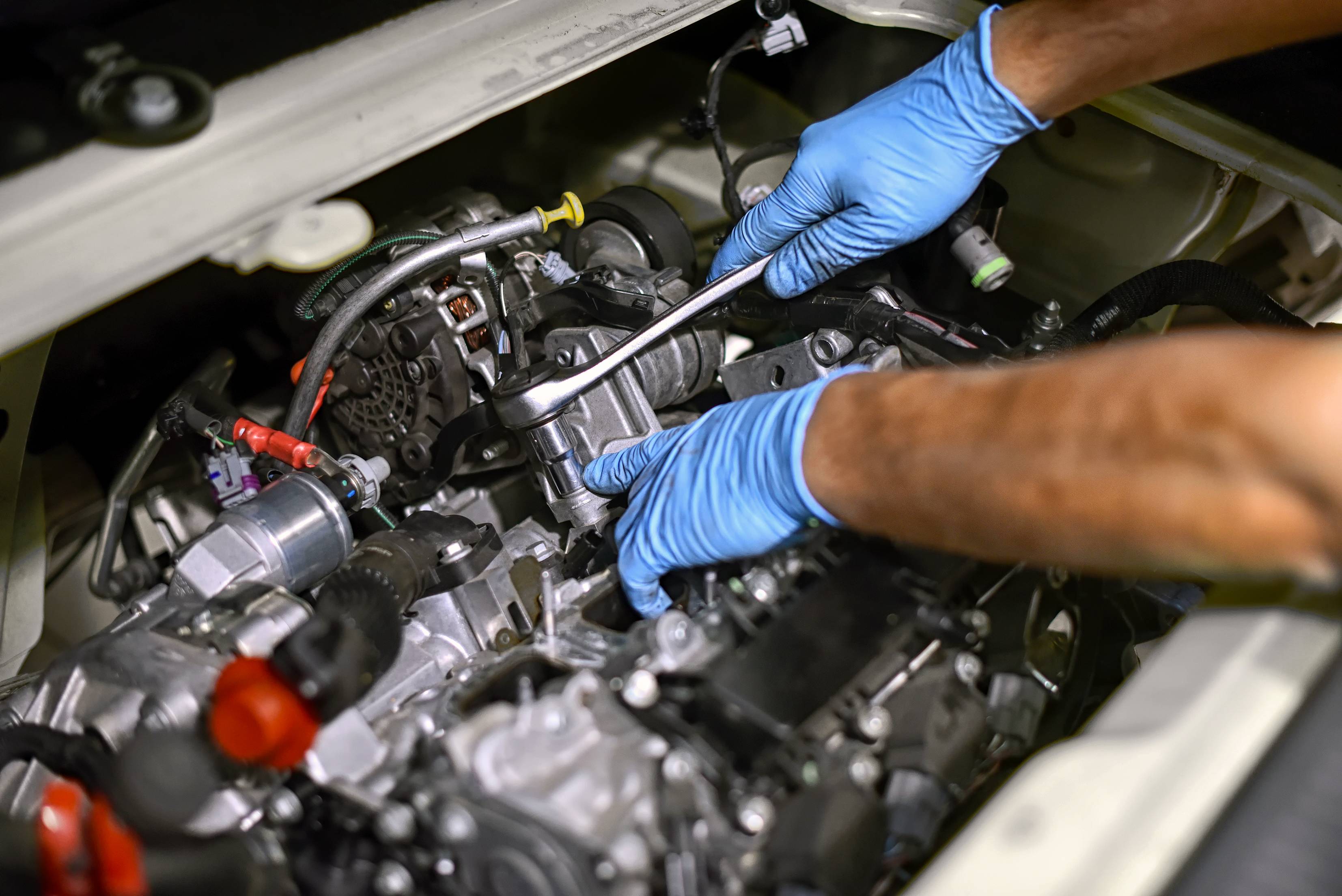
For the driver, the key is to observe the context. If the failure is preceded by dimming lights and electrical strangeness while driving, the alternator is the protagonist of this tragedy. If the car simply refuses to wake up after a long rest, with no other symptoms, the battery is likely the culprit. And if you smell burning rubber or hear a squealing noise from the engine bay, the belt that drives the alternator might be slipping, which is a far cheaper fix than replacing either major component.
When the Road Decides for You
Sometimes, you do not have the luxury of a garage diagnosis. Sometimes, the decision is made for you on the side of the road, with the hazard lights blinking and the heat radiating off the asphalt. In these moments of vehicular crisis, the priority shifts from diagnostic precision to logistical survival. You need a solution that returns mobility and safety.
This is where the ecosystem of support in the emirate becomes the invisible hand that guides your next move. If your charging system fails completely—whether it is a battery that cannot hold a charge or an alternator that has seized—the immediate need is not for a mechanic, but for connectivity to a service provider. Understanding the landscape of support available is crucial; whether you are stuck in the industrial area or near the university, knowing who to call transforms a disaster into a mere inconvenience. It is in these critical moments that a reliable service network proves its worth, and for drivers in the central region, securing efficient roadside assistance sharjah can mean the difference between an hour of frustration and an entire afternoon lost in the heat, ensuring that whether you need a jump-start or a tow to a diagnostic center, help is already on the way .
The Verdict of Voltage
So, how do you decide? Look at the totality of the evidence. If the vehicle is experiencing electrical gremlins—lights that dance to the rhythm of the turn signals, gauges that drop to zero and bounce back—you are hunting an alternator. If the engine simply lacks the vigor to turn over, you are likely hunting a battery.
But consider the age of the components. A battery older than three years in the UAE climate is living on borrowed time. If your alternator is original to a vehicle with over 150,000 kilometers, its mechanical parts are likely worn. The decision often comes down to a simple rule of automotive thumb: repair the system that caused the failure, but be prepared to replace the component that was damaged as a consequence.
Conclusion: The Symbiosis of Power
Your car does not have a battery problem or an alternator problem. It has a charging system problem. Viewing these components as separate entities is a recipe for repeated breakdowns and financial inefficiency. The battery is the reservoir, and the alternator is the pump. If the reservoir is cracked, you replace it. If the pump is leaking, you rebuild it. But if you replace the reservoir without checking the pump, you will soon find your new reservoir empty again.
The next time your car refuses to start, listen to the silence. It is telling you a story. It might be the story of a battery that has simply reached the end of its chemical life, or it might be a cautionary tale of an alternator working itself to death. The art of the decision lies in knowing which story is true, ensuring that the heartbeat of your vehicle remains strong, steady, and ready for the road ahead.


