


Expanding your business into India can unlock huge opportunities — but only if your products meet Indian regulatory standards. One of the most important requirements is the Foreign Manufacturer Certification Scheme (FMCS), governed by the Bureau of Indian Standards (BIS).
Unlike domestic certification, FMCS is specifically designed for overseas manufacturers, ensuring that imported products meet the same safety and quality standards as those produced in India.
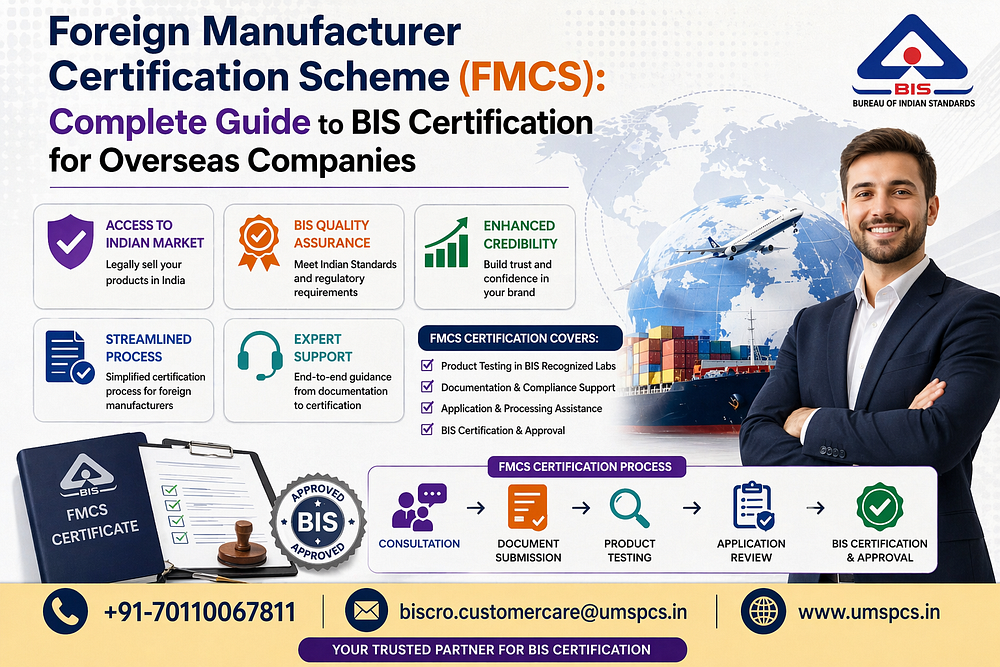
What is the Foreign Manufacturer Certification Scheme (FMCS)?
The FMCS is a BIS certification scheme that allows foreign manufacturers to obtain a license to use the ISI mark on products exported to India.
👉 In simple terms, FMCS acts as a gateway for international products to legally enter the Indian market.
How FMCS is Different from Other BIS Schemes
Understanding how FMCS differs from other BIS schemes is important:
- ISI Certification : For Indian manufacturers
- CRS Registration in Noida: For electronics and IT products
- FMCS Certification: For foreign manufacturers exporting to India
👉 FMCS is unique because it involves international factory inspection and compliance verification.
Who Needs FMCS Certification?
FMCS is required for:
- Foreign manufacturers exporting regulated products to India
- International brands entering the Indian market
- Exporters dealing with industrial or consumer goods
- Companies supplying products under Quality Control Orders (QCOs)
Key Requirements Under FMCS
To obtain FMCS certification, foreign manufacturers must meet several conditions:
✔️ Compliance with Indian Standards (IS Codes)
Products must meet specific BIS standards.
✔️ Factory Inspection
BIS officials inspect the manufacturing facility abroad.
✔️ Product Testing
Samples must be tested in BIS-approved laboratories.
✔️ Authorized Indian Representative (AIR)
A local representative must be appointed in India.
Step-by-Step Journey of FMCS Certification
Instead of just steps, think of FMCS as a compliance journey:
1. Understanding Product Applicability
Check whether your product falls under mandatory BIS certification.
2. Aligning with Indian Standards
Ensure your product meets the required IS specifications.
3. Appointing an AIR
Your Indian representative acts as a bridge between you and BIS.
4. Preparing Documentation
Compile detailed manufacturing and quality records.
5. Testing & Verification
Products are tested for compliance and safety.
6. Inspection & Approval
BIS inspects your factory and grants certification.
👉 This journey ensures full compliance before market entry.
Real Challenges Foreign Manufacturers Face
FMCS certification is not just paperwork — it involves real challenges:
- Understanding Indian regulatory framework
- Managing cross-border communication
- Coordinating factory inspections
- Handling technical documentation
- Meeting strict timelines
👉 These challenges often lead to delays without expert help.
Why Expert Support is Essential
Working with a professional consultant can simplify the entire process.
Benefits of Expert Assistance:
- Clear understanding of BIS requirements
- Error-free documentation
- Faster coordination with BIS
- Reduced approval timelines
- Smooth inspection handling
Why UMSPCS is a Trusted FMCS Consultant
UMS Product Compliance Services (UMSPCS) specializes in helping foreign manufacturers achieve BIS certification.
What UMSPCS Offers:
- FMCS certification support
- AIR appointment assistance
- Documentation and compliance management
- Testing and inspection coordination
- End-to-end certification services
Key Advantages:
- ✔️ Global compliance expertise
- ✔️ Fast-track certification process
- ✔️ Strong regulatory knowledge
- ✔️ Reliable support for international clients
UMSPCS ensures that your entry into the Indian market is smooth and compliant.
Benefits of FMCS Certification
- Legal access to Indian market
- Use of ISI mark for credibility
- Smooth customs clearance
- Increased customer trust
- Competitive advantage
FAQs — Foreign Manufacturer Certification Scheme (FMCS)
1. What is FMCS certification?
It is a BIS certification scheme for foreign manufacturers exporting products to India.
2. Is FMCS certification mandatory?
Yes, for products covered under BIS regulations.
3. Do foreign manufacturers need an AIR?
Yes, appointing an Authorized Indian Representative is mandatory.
4. Does BIS inspect foreign factories?
Yes, BIS officials conduct factory inspections outside India.
5. Why choose UMSPCS?
UMSPCS provides expert, fast, and reliable FMCS certification support.
Conclusion
The Foreign Manufacturer Certification Scheme (FMCS) is a critical requirement for overseas companies entering the Indian market. While the process involves multiple steps like testing, inspection, and documentation, it ensures that products meet India’s strict quality standards.
With expert support from UMS Product Compliance Services (UMSPCS), foreign manufacturers can complete the certification process smoothly and expand their business in India with confidence.


