


Complete Guide for Foreign Manufacturers Exporting to India
By UMS Product Compliance Services (UMSPCS)
If you are a foreign manufacturer planning to enter the Indian market, obtaining certification under the Foreign Manufacturers Certification Scheme (FMCS) is essential. Issued by the Bureau of Indian Standards (BIS), this certification allows you to use the ISI mark on your products and legally sell them in India.
For businesses working with consultants in Delhi, understanding the FMCS process step by step can help avoid delays and ensure smooth approval.
What is BIS FMCS Certification?
FMCS (Foreign Manufacturers Certification Scheme) is designed for manufacturers located outside India who want to export products that fall under mandatory BIS standards.
Once approved, manufacturers can:
- Use the ISI mark on their products
- Sell products legally in India
- Build trust with Indian consumers and buyers
Why FMCS Certification is Important
Entering the Indian market without proper certification is not possible for regulated products. FMCS certification ensures:
- Compliance with Indian safety and quality standards
- Legal approval to import and sell products
- Increased credibility and market acceptance
- Better opportunities in Indian markets
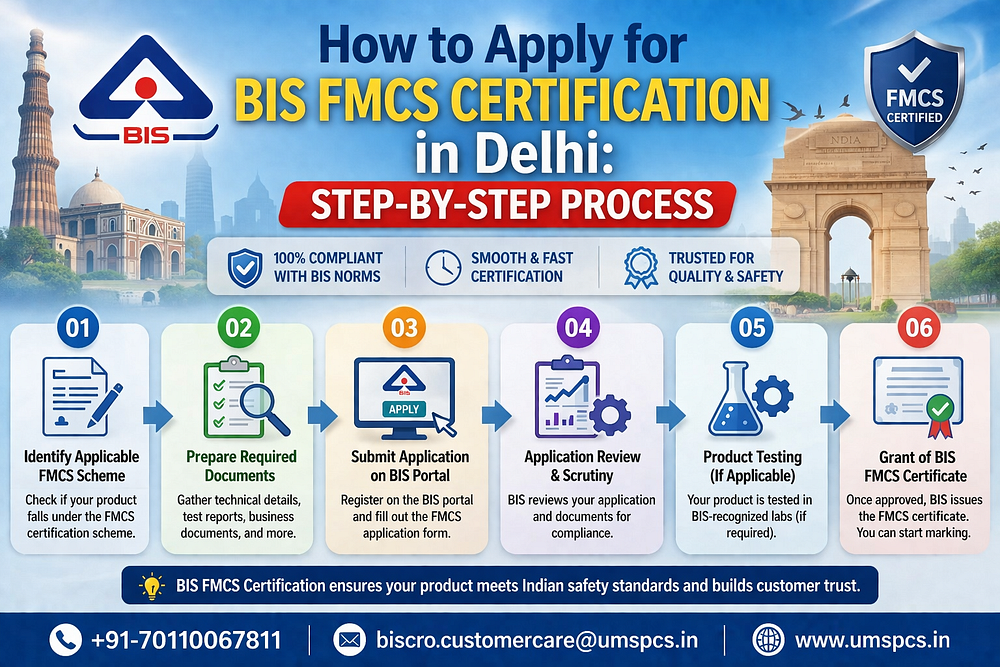
Step-by-Step Process to Apply for BIS FMCS Certification in Delhi
Here’s a clear and practical breakdown of the FMCS application process:
Step 1: Identify Applicable Indian Standard (IS Code)
The first step is to determine the correct Indian Standard (IS code) applicable to your product.
👉 Choosing the wrong standard can delay or reject your application.
Step 2: Appoint an Authorized Indian Representative (AIR)
Foreign manufacturers must appoint an Authorized Indian Representative (AIR) based in India.
The AIR is responsible for:
- Communication with BIS
- Handling documentation
- Managing compliance requirements
Step 3: Prepare Documentation
Accurate documentation is critical for FMCS approval. Required documents typically include:
- Manufacturing details
- Product specifications
- Quality control procedures
- Test reports (if available)
- Factory layout and process details
Step 4: Submit Application to BIS
The application is submitted to BIS along with all required documents and details.
👉 Any error in documentation can cause delays, so careful preparation is essential.
Step 5: Product Testing
Product samples are tested in BIS-approved laboratories to verify compliance with Indian standards.
Step 6: Factory Inspection by BIS
BIS officials visit the manufacturing facility (outside India) to:
- Verify production processes
- Check quality control systems
- Ensure compliance with Indian standards
👉 This is one of the most important steps in FMCS certification.
Step 7: Grant of BIS License
Once all requirements are fulfilled, BIS grants the license, allowing you to:
- Use the ISI mark
- Export and sell products in India
Common Challenges in FMCS Certification
Many foreign manufacturers face difficulties such as:
- Understanding Indian standards
- Managing documentation requirements
- Coordinating factory inspections
- Delays due to incomplete applications
👉 Working with an experienced consultant can help avoid these issues.
Why Choose UMSPCS for FMCS Certification in Delhi?
UMS Product Compliance Services (UMSPCS) is a trusted BIS consultant offering expert FMCS certification services.
What UMSPCS Offers:
- Complete FMCS certification support
- Assistance in appointing AIR
- Accurate documentation preparation
- Coordination for testing and inspection
- Fast and smooth approval process
Key Benefits:
- Experienced compliance experts
- Strong presence in Delhi NCR
- End-to-end service
- Reliable and transparent approach
UMSPCS ensures your certification process is efficient and hassle-free.
Benefits of BIS FMCS Certification
- Legal entry into Indian market
- Use of ISI mark for credibility
- Increased trust among customers
- Competitive advantage
- Compliance with Indian regulations
FAQs — BIS FMCS Certification in Delhi
1. What is FMCS certification?
FMCS is a BIS certification scheme for foreign manufacturers exporting products to India.
2. Is FMCS certification mandatory?
Yes, for products under mandatory BIS standards.
3. Do foreign manufacturers need an Indian representative?
Yes, appointing an Authorized Indian Representative (AIR) is mandatory.
4. How long does FMCS certification take?
The timeline depends on documentation, testing, and inspection processes.
5. Why choose UMSPCS?
UMSPCS provides expert guidance, faster processing, and complete FMCS certification support.
Conclusion
Applying for BIS FMCS certification in Delhi may seem complex, but with a clear step-by-step approach, it becomes manageable. From documentation to factory inspection, every stage requires attention to detail.
With expert support from UMS Product Compliance Services (UMSPCS), foreign manufacturers can achieve certification smoothly and expand their presence in the Indian market without delays.


